From Truck Stops to a Culinary Tradition
Every food has an origin story, though not all are told accurately. Karahi’s history in Lahore is often reduced to a vague sense that it’s “always been there.” That undersells how the dish actually developed, and why certain neighborhoods and establishments came to define it.
The Origins of the Karahi Pan
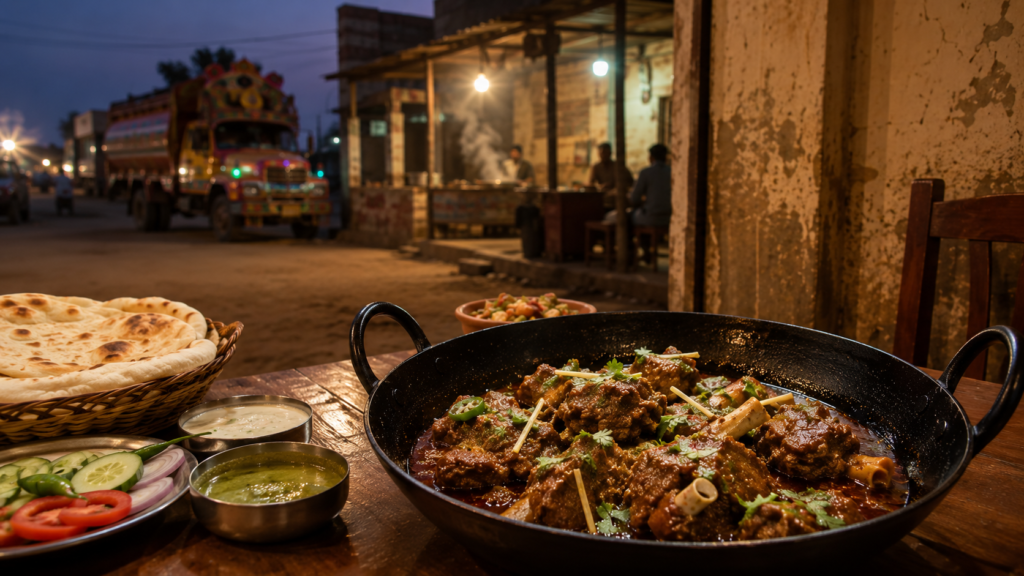
The karahi is a deep, wide, wok-like vessel. Its roots predate the specific dish now associated with it. The design is wide at the top and narrows toward the base. This shape was originally practical rather than stylistic.
It allowed for high, even heat. That suited the quick-searing and slow-simmering combination many meat-based curries in the region required. Over time, the pan gave its name to the dish itself. This naming convention is common in South Asian cooking, where the vessel and the meal became inseparable in everyday language.
Why Truck Stops Became Unlikely Culinary Landmarks
Lahore’s Truck Adda area is a hub for freight and long-haul drivers. It might seem like an unusual birthplace for a beloved culinary tradition. But it makes a certain amount of sense. Truck stops needed to feed large numbers of hungry travelers quickly, affordably, and reliably, night after night.
That environment rewarded consistency. Restaurants had to cook well under pressure and maintain quality across hundreds of orders a night. Karahi fit that demand perfectly. It was cooked fresh to order in individual portions. Once a kitchen had its process down, it could be prepared quickly while still tasting like something made with real care.
This is the backdrop against which Ilyas Dumba Karahi opened in 1985, at Truck Adda itself. In that environment, consistency wasn’t optional. If the food wasn’t good, the trucks simply stopped somewhere else the next night.
The Rise of Dumba as a Distinct Karahi Tradition
Chicken and standard mutton karahi remained common across Lahore. Dumba karahi, however, carved out its own identity. It was built specifically around the richness of fat-tailed sheep meat. This wasn’t an accident of availability. Dumba meat requires more careful sourcing and a longer, more attentive cooking process to get right.
As a result, it developed a reputation as the more serious, more demanding version of the dish. Restaurants that executed it well built stronger reputations than those simply offering the common chicken alternative. For a deeper look at what separates dumba karahi from other types, this comparison of chicken vs mutton vs dumba karahi breaks down the practical differences.
How Karahi Moved from Roadside Stalls to Family Tables
Lahore expanded over the decades. Residential neighborhoods like DHA developed further from the city’s older commercial districts. Demand for the same quality of food moved with the population. What was once associated mainly with truck stops and roadside dhabas gradually became a fixture of family dinners, celebrations, and weekend gatherings.
This shift didn’t happen because the dish changed. It happened because families wanted the same standard, closer to home. That demand eventually led to a second, more residential-facing branch near Askari 11. It extended the same Truck Adda standard into DHA Phase 6, decades after the original opened.
What the Tradition Looks Like Today
Modern dumba karahi hasn’t strayed far from its roots. That’s true, at least, in kitchens that take the tradition seriously. The cooking method remains largely unchanged: fresh meat, slow preparation over open flame, and a carefully balanced masala.
What has changed is context. Karahi now appears at family celebrations and weekend gatherings just as often as it once did at truck stops and late-night roadside stops. For readers curious about the process still used today, this breakdown of how dumba karahi is made documents the method in detail.
Where the Tradition Continues
History matters most when it’s still being lived out, not just recounted. Ilyas Dumba Karahi still operates from its original Truck Adda location, alongside its newer DHA branch. Together, they represent a direct link between that early roadside tradition and its modern audience, without the standard being diluted along the way.
📞 Call now: 03041114535 (DHA Branch 1) or 03004535465 (Truck Adda Branch 2) 📍 Truck Adda, Ravi Link Road, and DHA Phase 6, near Askari 11, Lahore
Frequently Asked Questions
The karahi pan itself has long-standing roots in South Asian cooking, with the dish’s name derived from the vessel used to prepare it.
Truck stops needed to feed large numbers of travelers reliably and consistently, an environment that helped establish karahi as a dependable, quickly prepared dish.
It required more careful sourcing and a more demanding cooking process, which set it apart as a richer, more serious variation of the dish.
Yes, at kitchens that maintain the tradition seriously, the core method, fresh meat and slow cooking over open flame, remains largely unchanged.
The original location opened at Truck Adda in 1985.
Yes, the same standards established at Truck Adda were carried directly into the DHA branch.